
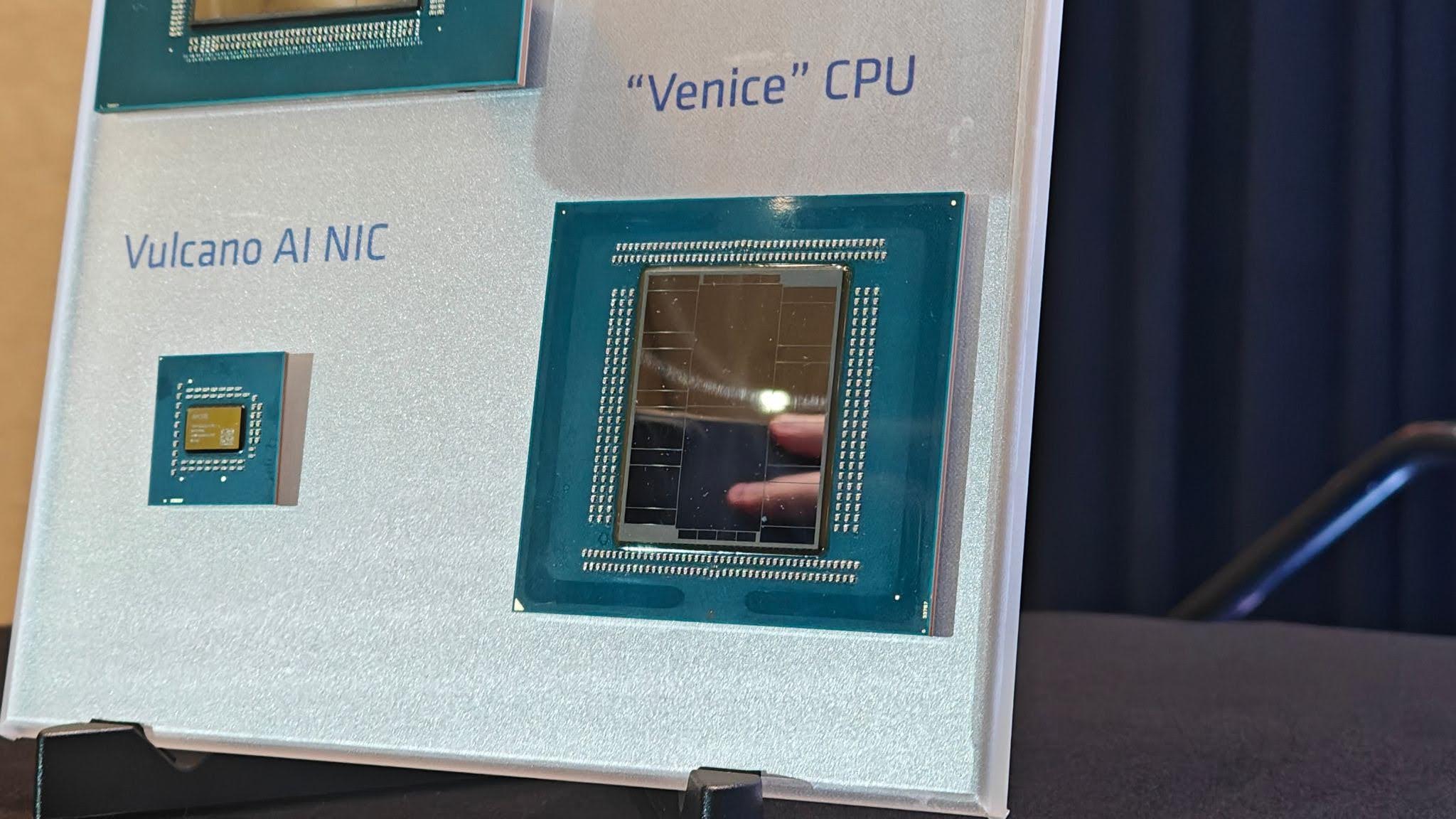
Venice-X maxes out the family’s frequency for the first time.
AMD missed out on deploying Turin-X CPUs in the previous generation, giving its 3D V-Cache tech a four-year hiatus from the data center following the launch of Genoa-X in 2023. In the second half of next year, 3D V-Cache is coming back for HPC with Venice-X, matching the 96 cores and 1,152 MB of L3 cache available on the EPYC 9684X (Genoa-X), but with vastly higher clock speeds, PCIe 6.0, and nearly four times the per-socket memory bandwidth.
After first bringing hybrid bonding to EPYC processors with Milan-X in 2022, AMD followed up a little over a year later with Genoa-X. Turin came and went without a chip sporting stacked SRAM, but now, it’s back with Venice-X. The critical change this time around doesn’t come from big jumps in core count — and consequently cache — as is the case with the standard SP7 lineup. Rather, it’s the 5.3 GHz boost clock speed, another pillar of Venice broadly, that’s particularly beneficial in the HPC workloads Venice-X targets.
AMD EPYC -X Chips
SKU | Family | Cores / Threads | Base / Boost Clock (GHz) | L3 Cache | TDP |
EPYC 7773X | Milan-X | 64 / 128 | 2.2 / 3.5 | 768 MB | 280 W |
EPYC 9684X | Genoa-X | 96 / 192 | 2.55 / 3.7 | 1,152 MB | 400 W |
EPYC 9006X (SKU unknown) | Venice-X | 96 / 192 | X.X / 5.3 | 1,152 MB | Unknown (likely 400 to 600 W) |
As you can see from the top EPYC -X chips from previous generations, boost clocks were significantly lower for the X chips, and higher frequencies were available within the standard chips from each family. Milan scaled up to 4.1 GHz, while Genoa could climb to 4.4 GHz, just not on the EPYC -X chips. Venice-X brings up to the maximum 5.3 GHz boost clock available across the range, unifying a high frequency with a large pool of bonded L3 for HPC workloads.
There are still details missing about Venice-X, including the base frequency, how many SKUs are in the lineup and what their specs are, and the TDP (though the 400 to 600 W range available to other Venice CPUs is likely). The chips appear to use the SP7 socket, however, keeping with previous EPYC -X chips.
The platform comes with 96 PCIe 6.0 lanes, while the smaller SP8 platform targeting enterprises trades memory channels for PCIe lanes. Venice-X comes with the full 16-channel memory setup available on SP7, including support for MRDIMMs at 12,800 MT/s that can drive the quoted 1.6 TB/s of per-socket memory bandwidth.
The critical marriage with Venice-X for HPC workloads, according to AMD, is high frequency with a large pool of stacked cache. AMD currently maintains both 3D V-Cache and high-frequency EPYC chips in its HPC fleet to run its internal EDA workloads. AMD Fellow Phil Steinke says the company runs performance analysis on these workloads to characterize performance, optimize EPYC designs, and push partners to optimize their software.
The biggest consumer on the HPC fleet by far are function verification workloads at over half of AMD’s used compute, according to Steinke. These are logic simulations that show up in tools like Cadence Xcelium, and Steinke says the EPYC team is running these workloads “24 x 7 x 365.”
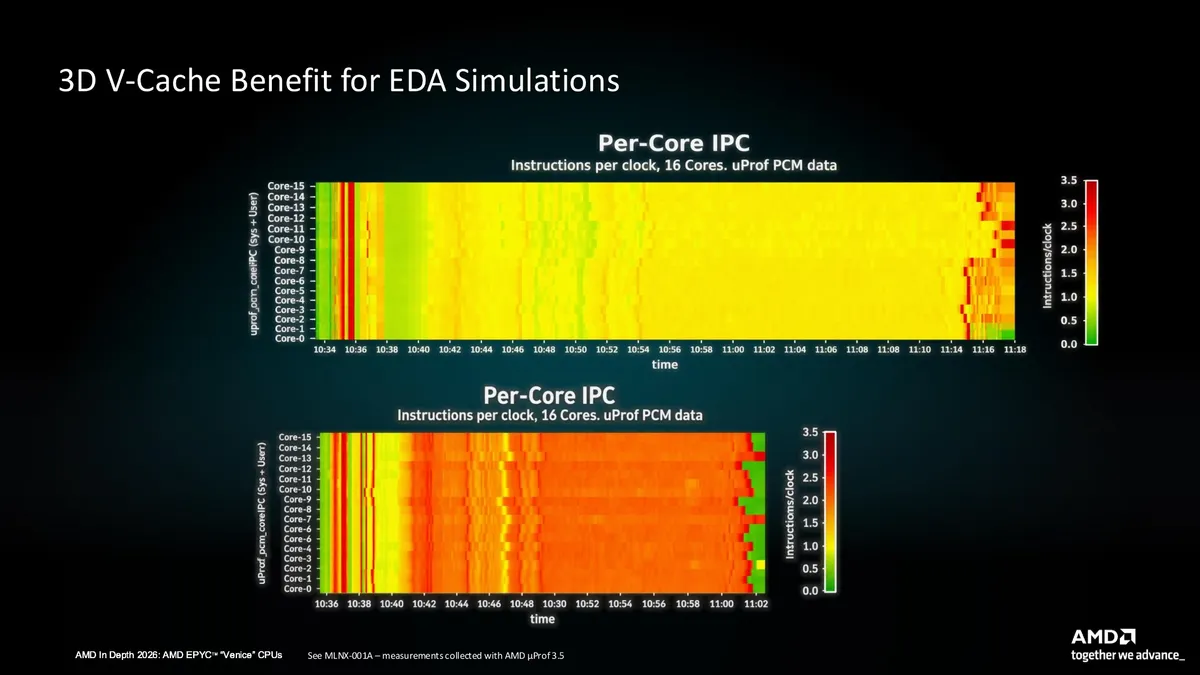
An example of one such workload is above, measuring IPC with AMD’s uProf monitoring utility. With 3D V-Cache, AMD says this workload completes 40% faster at around double the instructions per clock. AMD didn’t clarify which chips it was comparing or what application it was using. However, the comparison is between an EPYC fleet with and without 3D V-Cache.
Steinke says AMD is able to now move toward a single chip with Venice-X, maintaining the cache advantages in workloads like functional verification while driving the EDA workloads more sensitive to frequency. “I mentioned we have a mix of high frequency and 3D V-Cache CPUs in our data center, and that’s because through Milan and Genoa, the high frequency parts were always a little higher on the frequency side,” Steinke said. “You don’t have that dichotomy [with Venice-X]. You can get the best of both worlds in a single CPU, and this is what we’re really excited to be picking up for our own use.”
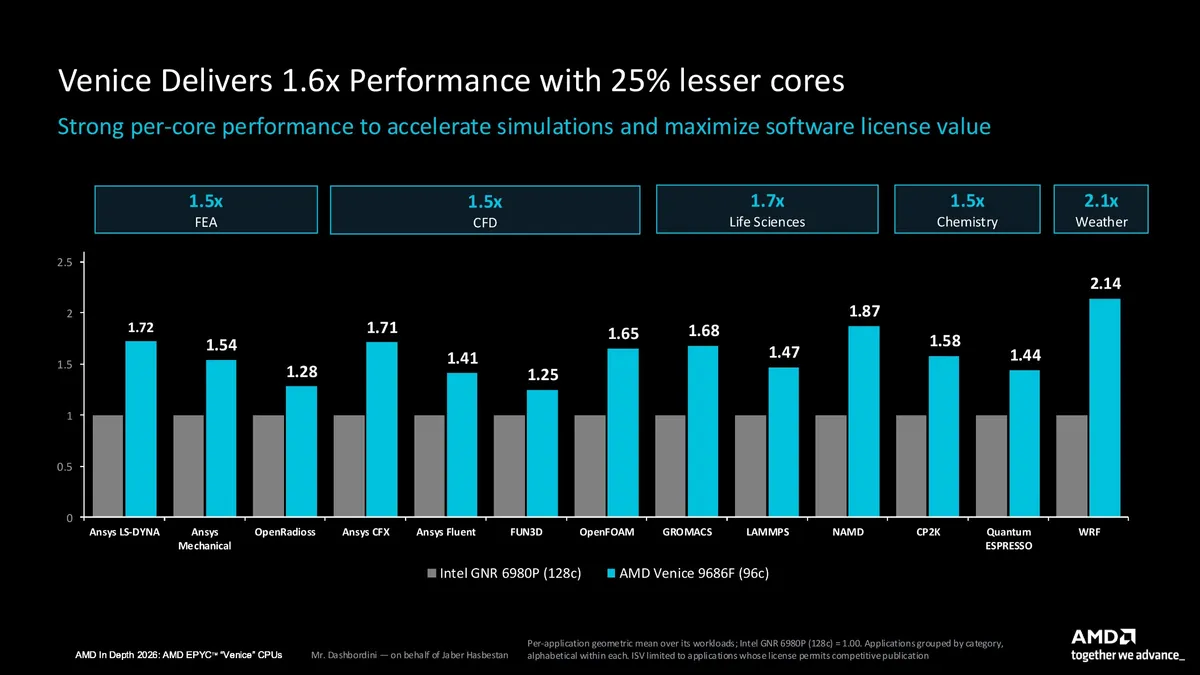
AMD hasn’t shared any benchmarks for Venice-X yet, but it provided some more specific HPC benchmarks comparing its high-frequency EPYC 9686F to Intel’s Xeon 6980P in several HPC workloads, such as computational fluid dynamics. In AMD’s testing, the 9686F was 1.6x faster in these benchmarks while running 32 fewer cores.
We had a chance to test the EPYC 9686F along with the dense EPYC 9996, which you can read more about in our Zen 6 EPYC Venice deep dive and benchmarking article. And indeed, the EPYC 9686F looks very impressive in some of the HPC workloads we ran.
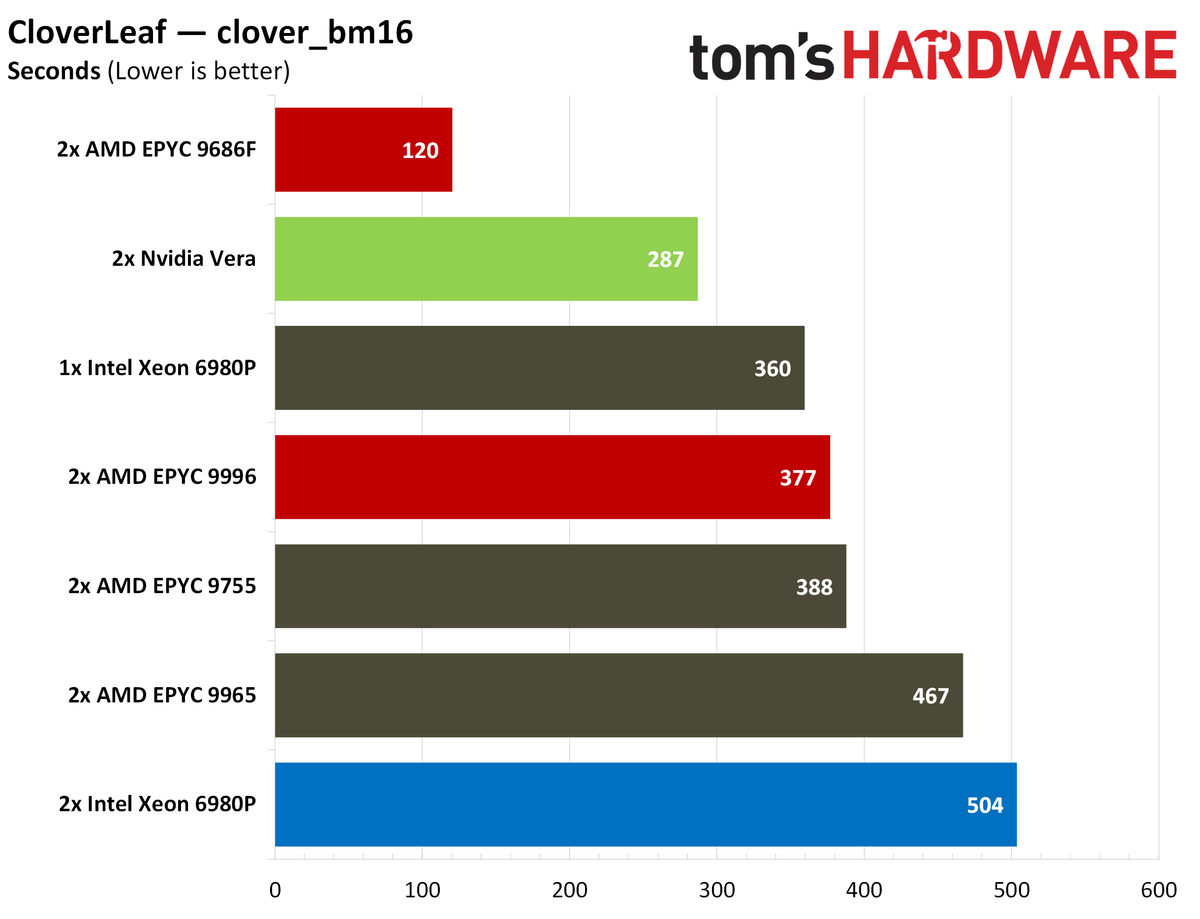
We were only able to test a 2P configuration, and as evidenced by the sole Xeon 6980P, CloverLeaf is sensitive to latency. Even then, the 2P EPYC 9686F completed the complex hydrodynamics simulation in about a third of the time as a single Xeon 6980P.
AMD says it’s currently using MEXT, its AI-driven flash-as-DRAM technology, to bolster the amount of memory available for its EDA workloads. When it deploys Venice-X, Steinke says the company will continue using MEXT.
Venice-X CPUs are launching in the second half of 2027, while SP7 and SP8 Venice CPUs are rolling out now. Also coming in the second half of next year is AMD’s Verano, which it’s pitching as an AI host node that leverages SOCAMM2 LPDDR5X memory.
Source: tomshardware